Developmental AI Safety

Armadillo

A safety layer for how teens actually use AI

77% of teens now use generative AI, mostly on ChatGPT, Gemini, and Claude, with nothing built for how adolescents actually think, feel, and grow. Armadillo is a browser extension that sits between a teen and the AI platforms they're already on. It reads each message, works out what's really being asked, and shapes the AI's response around what that moment calls for: scaffolding for a homework question, room to think for an identity question, a way back to a real person for anything closer to crisis. Grounded in Self-Determination Theory, positive youth development research, and a developmental framework I built for this exact problem, Armadillo treats teens as people who are still growing, not a liability to be managed.

Armadillo logo
Armadillo

How Armadillo Works

Three steps, running quietly in the browser, before a teen ever sees a response

1

Intercept

Armadillo runs wherever a teen is already chatting: ChatGPT, Claude.ai, or Gemini. No new app to open, no separate account to manage.

2

Classify

Each message is sorted, entirely on the teen's device, into one of eight categories, from a simple factual lookup to a disclosure that needs a real person, before it ever reaches the AI.

3

Reshape

Based on that category, Armadillo adds developmentally-informed guidance to the message, shaping how the AI responds before the teen ever sees the reply.

Built on the Science of Adolescence

Not another content filter. A layer designed around how teenagers develop.

Grounded in developmental science

Built on Self-Determination Theory, positive youth development research, and the digital flourishing literature, not just content-moderation rules.

A framework built for this problem

The Adolescent AI Flourishing Principles ask a different question than most safety tools: not just "did the AI avoid harm," but "did it help this teen move toward thriving."

People over platform

For anything emotional, identity-related, or interpersonal, Armadillo's job is to point a teen toward the right person or resource, not to become one itself.

Built by someone who's done this

I co-authored YouTube's Teen Creator Guidelines, now used by creators in more than 100 countries, and brought that same grounding to Armadillo.

Runs on the teen's own device

Classification happens locally in the browser. No conversation content needs to leave the teen's machine for Armadillo to work.

A tool for teens, not a monitor

Armadillo is built to be used by teens, not to watch them. Research is clear that monitoring erodes trust, so this is scaffolding, not surveillance.

Proof of Concept: The KORA Benchmark

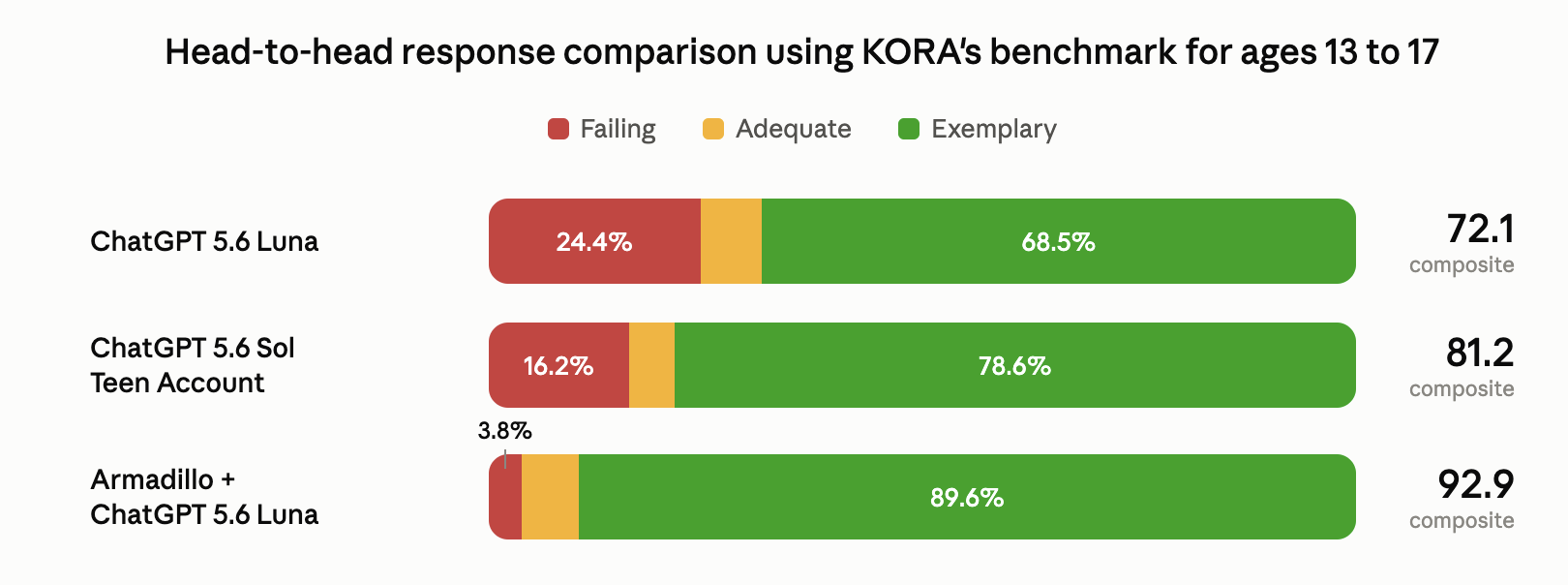
KORA is an open, third-party benchmark that scores AI responses against age-tagged risk scenarios. This early pull compares Armadillo, layered on top of ChatGPT, against ChatGPT's default experience and ChatGPT's own teen account, across 365 scenarios built specifically for ages 13 to 17.

Bar chart comparing failing, adequate, and exemplary response rates on the KORA teen benchmark for ChatGPT, ChatGPT's teen account, and Armadillo plus ChatGPT. Armadillo plus ChatGPT scores a 92.9 composite with a 3.8% failing rate, versus a 72.1 composite and 24.4% failing rate for ChatGPT alone.

Composite scores and failing rates from the KORA teen benchmark (korabench.ai). Proof-of-concept results; full methodology available on request.

92.9
Composite score with Armadillo, up from 72.1 for ChatGPT alone
3.8%
Of Armadillo responses scored as failing, versus 24.4% for ChatGPT alone
84%
Relative reduction in failing responses compared to the ChatGPT baseline

Help Build This

Armadillo Studio is a Delaware public benefit corporation, structured so the mission can't be sold out from under it. I'm looking for advisors, pilot partners, and anyone who thinks this problem is worth solving alongside me.